 Bob Rahm |
September 26, 2026
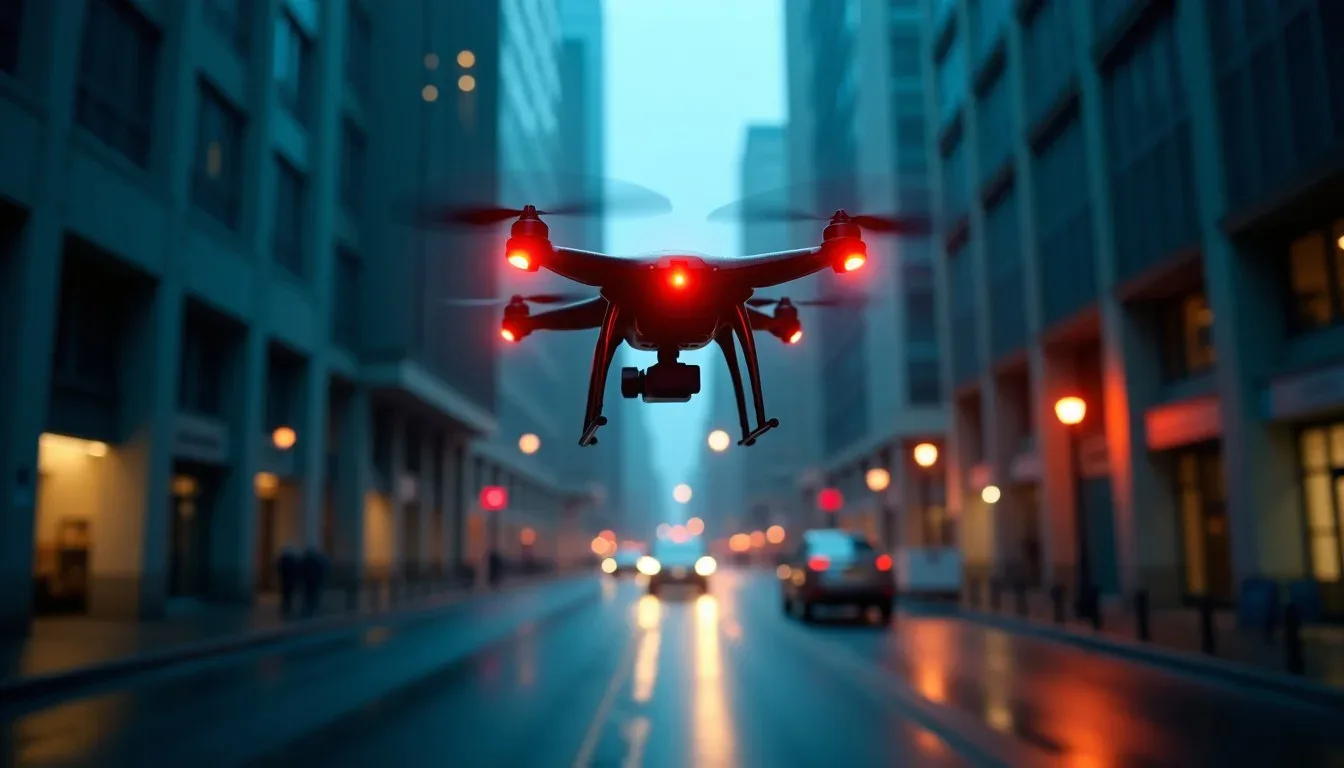
The Blue List is a cybersecurity roster. Hudson Yards is a flying problem.
In September 2026 the Department of Homeland Security's National Urban Security Technology Laboratory published SAVER-T-R-39, the Blue UAS for First Responders Comparative Assessment Report. The PDF is dated September 2026 and appeared on the SAVER page on September 17. It rolls up three operational assessments run from June 2024 through July 2025: College Station, Texas (rural), Miami (urban), and Hudson Yards in Manhattan (dense urban canyon).
Twenty-six public-safety pilots from 13 states flew the aircraft. The evaluator pool included NYPD, FDNY, Boston Fire, Los Angeles Police, Michigan State Police, Texas DPS, the Coast Guard, and Customs and Border Protection. The equipment sits on the Authorized Equipment List as 03OE-07-SUAS, "System, Small Unmanned Aircraft." That is the line most grant writers cite when they buy a Blue airframe and call the job done.
The canyon did not accept that shortcut.
What actually flew at Hudson Yards
NUSTL brought five Blue platforms to Manhattan. Three were excluded from scoring because they could not hold position without drifting:
- Ascent AeroSystems Spirit — insufficient GNSS reception to hold position. Evaluators also noted that the coaxial airframe gave no physical cue of aircraft heading.
- Freefly Astro (Sony LR1 EO/IR and laser rangefinder) — would not enter position mode; a safety pilot could not recover a hold even after climbing. In Miami the same airframe had already started losing video and control around 750 feet from the controller at Bayfront Park.
- Teal 2 — could not launch safely without a GPS lock. The problem showed up in familiarization flights at Fort Totten in Queens, before the Hudson Yards scorecard. Pairing and Remote ID faults in earlier rounds had already delayed launch by as much as 15 minutes. Miami deployability scored 1.5.
Two Blue airframes were scored at Hudson Yards.
Skydio X10D posted 4.0 in Miami and 3.7 at Hudson Yards, the best overall mark in the six-system series. NUSTL credited fast deployment, controls, and the NightSense infrared lighting kit. Camera-based autonomy kept the aircraft stable when GNSS degraded. That is the useful sentence in the report: vision hold is not a luxury feature in a canyon. It is the difference between a scored flight and a grounded one.
The X10D was not clean. In Miami, half the operators saw video discontinuities and pixelation in motion. At Hudson Yards some evaluators lost the link below 100 feet and at short horizontal ranges between high-rises. Changing radio frequency helped and was still logged as a disadvantage. One flight needed a controller reset and a hard reboot; the aircraft landed in place on obstacle avoidance. As tested, the kit cost $28,382. October 2024 deliveries were going out with one battery instead of three after China sanctioned Skydio and cut a battery supplier.
Parrot ANAFI USA GOV completed the series at every site and scored 2.4 overall in the complex-urban day-and-night set. Command-and-control at Hudson Yards scored 1.8 out of 5. Latency scored 1.7. The aircraft lost the link as close as 50 feet from launch. One loss ended in a flyaway. It could not take off between two high-rises until the radio was reset and the launch point moved. It was the lowest-priced Blue system in the tested set.
A sixth Blue airframe, Skydio X2D, flew only in Texas. The X10D replaced it after X10D reached the Blue List mid-2024. X2D needed about 2.5 minutes to recalibrate after every battery change.
Covered-nation platforms were flown at Hudson Yards because, NUSTL wrote, response agencies still rely on them. The January 2026 QuickLook named DJI Matrice 4T and Matrice 30T among the aircraft that could hold position with little drift and were deemed safe to fly there, alongside ANAFI USA GOV and X10D. The public September comparative report does not print those scores. Agencies can request them from DHS. This article does not invent them.
The four findings that belong on a preflight card
NUSTL put four takeaways at the top of the comparative report:
- GPS cannot be relied on in dense cities.
- The controller-to-aircraft link is inconsistent.
- Deployment takes too long. The summary line is blunt: "Deployment time was unacceptable for most first responders."
- Cost is a barrier. Tested Blue systems ran from $13,964 to $56,195. Cost was not a scored criterion and still came up in every focus group.
DHS adds the operational consequence: if a drone takes too long to launch or costs too much, crews go back to ground methods.
That last sentence is the contractor problem. A Part 107 shop selling a Blue airframe into a downtown public-safety or inspection contract is selling launch time and position hold, not a logo on a cleared-list PDF.
What this does not change in Part 107
Nothing in SAVER-T-R-39 amends 14 CFR Part 107. Visual line of sight, the 55-pound small-UAS box, airspace authorization, Remote ID, and operations-over-people rules are unchanged. A public-safety agency still flies civil under Part 107 or public under a COA. A contractor still needs the certificate, the waiver or COA conditions that match the mission, and a site survey that treats GNSS and RF as weather.
The report does change how a competent remote pilot writes that survey. An open-sky check at a park does not stand in for a canyon. If the job is between buildings — a mid-block structure fire, a downtown facade inspection, a rail cut, a hospital courtyard — the aircraft either has a demonstrated non-GNSS hold or the statement of work says the flight may not launch.
Remote ID showed up as a delay, not as a legal theory. Teal 2 pairing and RID faults ate minutes that a first-due crew does not have. A Part 107 operator who treats RID as a checkbox at the hangar, rather than a timed step at the scene, will miss the same clock.
What a Part 107 shop should do with SAVER-T-R-39
- Stop treating Blue List membership as an urban performance spec. Clearance is supply chain. Hudson Yards is aeromechanics and RF.
- Require a GNSS-denied or urban-canyon demonstration in any bid for downtown public-safety, facade, or courtyard work. Write "position hold without GNSS" into acceptance tests.
- Time the full launch sequence on the actual airframe, including RID pairing, battery swap, and radio reset. If the clock is measured in minutes, put that number in the proposal.
- Budget spare batteries. An X10D that arrives with one pack is not a three-sortie aircraft.
- Separate grant language from flight language. AEL 03OE-07-SUAS gets the box bought. It does not get the box off the pad at Hudson Yards.
- If the customer still flies a covered-nation airframe, do not guess at NUSTL withheld scores. Point them at dhsblueuas@hq.dhs.gov or NUSTL and keep the public PDF honest.
- For DFR programs already buying docks, read this report next to the F10/MegaDock announcement. A 30-mile fixed-wing does not fix a two-block GNSS hole. Different aircraft, different failure.
The useful headline is not that American drones failed a test. Two of them flew. The useful headline is that three Blue airframes that survive a rural range and a Miami park did not survive a Manhattan canyon, and DHS printed the names.